BAT GENOMES

Evolution of Flight and Immunity
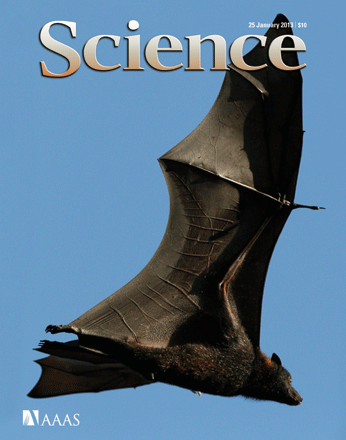


A juvenile male Pteropus alecto (black flying fox) spreading its wings (for adults, average wing span: ~1 meter; average weight range: 500 to 1000 grams). Bats, the only mammals capable of sustained flight, are among the world's most diverse mammals and are host to numerous deadly viruses. Comparative genome analyses have shed new light on the evolution of bat-specific traits, including flight and immunity. See page 456. Photo: Martin Asser Hansen/www.maasha.dk 
 
Bats are the only mammals capable of sustained flight and are notorious reservoir hosts for some of the world's most highly pathogenic viruses, including Nipah, Hendra, Ebola, and severe acute respiratory syndrome (SARS). To identify genetic changes associated with the development of bat-specific traits, we performed whole-genome sequencing and comparative analyses of two distantly related species, fruit bat Pteropus alecto and insectivorous bat Myotis davidii. We discovered an unexpected concentration of positively selected genes in the DNA damage checkpoint and nuclear factor κB pathways that may be related to the origin of flight, as well as expansion and contraction of important gene families. Comparison of bat genomes with other mammalian species has provided new insights into bat biology and evolution.  

ScienceVol. 339 no. 6118 pp. 456-460

EL REGRESO DE TRES DINOSAURIOS

1) EL DE TITO MONTERROSO

El dinosaurio
[Minicuento. Texto completo.]

Augusto Monterroso

Cuando despertó, el dinosaurio todavía estaba allí. 
FIN 

 
2) EL DE NATURE

Return of the dinosaur Mongolian researchers have finally got their hands on the Tarbosaurus bataar fossil (pictured) that was illegally smuggled out of Mongolia and came to auction in the United States last year. On 16 April, the team in New York began weighing and measuring the bones of the T. bataar specimen in preparation for customs registration and shipment back to Mongolia, which is expected shortly after it officially becomes Mongolian property on 6 May. The legal status of the fossil had been in limbo since Mongolia disputed its sale for more than US$1 million at a New York auction house last May. The 7.3-metre-long specimen is one of the most complete tyrannosau 


3) EL PRI


Arachnoscelis magnifica


Arachnoscelis magnifica, a predaceous katydid (Orthoptera: Tettigoniidae), on a leaf in the San Lorenzo forest of Panama. This attractive insect is but one of the ~25,000 arthropod species likely to live in this 6000-hectare forest, confirming the formidable diversity of arthropods, which appears to be 300 times that of mammals in tropical rainforests.

DEGRADACIÓN DE LA TIERRA

Drought kills agricultural profit
 
 
Land degradation and desertification are causing huge reductions in agricultural profits in the world’s poorest nations, according to a report presented at the United Nations Convention to Combat Desertification (UNCCD). The first assessment of its kind in more than 20 years calculates that Guatemala, for example, lost 24% of its agricultural gross domestic product to environmental degradation. The findings were presented at the UNCCD’s second scientific conference, on 9 April in Bonn, Germany. Nearly 3.7 million people in East Africa still require food assistance after droughts in Kenya (pictured) and other nations wiped out crops in 2011, the UNCCD says. “Desertification, land degradation and drought are key constraints to building social and environmental resilience, achieving global food security and delivering meaningful poverty reduction,” said UNCCD executive secretary Luc Gnacadja at the meeting.


NATURAL PRODUCTS EMERGENT

Fermentation rooms, at Warp Drive Bio, could open the door to natural product drug discovery


Natural compounds produced by the world’s microbes were once the go-to source of molecules for the drug industry before the chemistry dried up and big pharma went packing. Now, researchers hope that advances in genomics will bring companies back into the fold.

volume 19 | number 4 | april 2013 nature medicine

MEXICAN ARTIST: ATANASIO ECHEVERRIA

VISIBLE EMPIRE

Botanical Expeditions and visual culture in the hispanic enlightenment


From New Spain.

Mexican artist Atanasio Echeverría's watercolor of Erythrina divaricata.

Science 9 November 2012: Vol. 338 no. 6108 pp. 743-744  BOOKS ET AL.
HISTORY OF SCIENCE
Picturing Nature and Empire
Visible Empire Botanical Expeditions and Visual Culture in the Hispanic Enlightenment by Daniela Bleichmar University of Chicago Press, Chicago, 2012. 298 pp. $55, £35.50. ISBN 9780226058535.

Deafness diverted

Molecular therapy

Deafness diverted

Molecular therapy improves hearing and balance in a mouse model of a hereditary disease that causes deafness and balance disorders.
In humans, Usher syndrome is often caused by a mutation in the gene USH1C that results in the production of a truncated form of the protein harmonin — which normally guides development of the inner ear (pictured) — and leads to impaired hearing.
Jennifer Lentz at Louisiana State University in New Orleans, Michelle Hastings at Rosalind Franklin University in North Chicago, Illinois, and their collaborators injected newborn mice with DNA-like molecules that mask the mutation in the cell's protein-expression machinery, causing normal harmonin to be produced. This stopped the loss of inner-ear cells that respond to sound, improved low- and mid-frequency hearing and reduced behaviours associated with balance impairment such as head-tossing and circling. The effects lasted at least six months. The authors suggest that a similar approach may have therapeutic potential in human congenital deafness.

Nature 494, 150 (14 February 2013)


BOX JELLYFISH


Because most jellyfishes are venomous, they are also called sea wasps or marine stingers. Each tentacle contains more than 100,000 cnidocytes with nematocysts, small needles that inject venom into the victim. The most dangerous species are found in the tropical Indo-Pacific but the Caribbean species can also cause serious injuries. This picture was taken in Guadeloupe (French West Indies) by Dominique Marion, a senior scientist from the Institut de Biologie Structurale in Grenoble, France. Visit his galleries at http://diffraction-marine.net for more underwater pictures.

NEUROCIENCIA DE PECERA


The transparency of zebrafish larvae makes the animals ideal models for seeing deep into tissues. CHARLES MAZEL/VISUALS UNLIMITED/CORBIS


Tiny fish trapped in a virtual world provide a window into complex brain connections.
Virginia Hughes

A recently hatched zebrafish is swimming upriver for the first time. Its big round eyes, bulging on the front of its eyelash-sized body, scan the surroundings. Suddenly, it sees the scenery flying forwards as a gentle current pushes it backwards. The fish flicks its tail to try to stay in place. Or so it thinks.
In reality, the baby fish is paralysed and suspended in a water-filled Petri dish by glass pipettes. The dish sits on the stage of a US$100,000 microscope in the corner of a darkened, cluttered laboratory. A film, projected from below, has transported the fish to a virtual world in which moving bands of light and dark simulate passing underwater scenery.
Although the fish doesn't move, the motor neurons that control its tail are firing away, just as if it were swimming. And when fed into a computer, those signals can control the video display, giving the fish nearly every sign that it is swimming normally. All the while, Florian Engert's microscope peers deep into the fish's tiny, translucent brain to watch neurons glow green as they fire (see ‘A river of deceit’).

Nature 493, 466–468 (24 January 2013)

ECOLOGÍA URBANA


Colillas de Cigarro Repelen Pestes

VÍCTOR ARGAEZ/R. SOC.
 City-dwelling sparrows and finches incorporate the butts of smoked cigarettes into their nests, seemingly to ward off parasitic mites.

 Isabel López-Rull and her colleagues at the National Autonomous University of Mexico in Mexico City found that nests of house sparrows (Passer domesticus) and house finches (Carpodacus mexicanus; pictured) with higher levels of cellulose acetate, a component of cigarette butts, had fewer mites. The researchers attached fibres from either smoked or unsmoked cigarette filters to parasite-attracting heat traps and placed them in 27 sparrow and 28 finch nests. Traps bearing fibres from smoked filters, which contain more nicotine than those of unsmoked ones, captured fewer mites, suggesting that nicotine — and perhaps other compounds in cigarettes — repel the parasites.
Birds have long been known to line their nests with vegetation that deters parasites, and the authors suggest that the use of cigarette butts is an urbanized form of this earlier adaptation.

Research Highlights Nature 492, 156 (13 December 2012)

IN RETROSPECT The Origin of Life

Clifford P. Brangwynne and Anthony A. Hyman celebrate the first book to plausibly suggest how life began.

Aleksandr Oparin (seated) posited that life emerged from compounds in the atmosphere of early Earth.
“No religious or philosophical system, no outstanding thinker ever failed to give this question serious consideration.” So wrote Aleksandr Oparin more than 75 years ago, about the quintessential conundrum of how life self-assembled from inanimate components. The Soviet biochemist’s answer is his book The Origin of Life (1936). Roughly based on a pamphlet he published in 1924, this book is an enormous contribution to our understanding of life’s improbable beginnings. In it, Oparin argues that conditions on early Earth nurtured the synthesis of amino acids and their assembly into protocells.

Tony Hyman. NATURE | VOL 491 | 22 NOVEMBER 2012

CERTAIN NEURONS ARE CRITICAL REGULATORS OF BODY WEIGHT & FOOD INTAKE

a switch between peripheral
carbohydrate and lipid utilization

AgRP/NPY neurons are critical regulators of body weight and food intake. Concordant with their orexigenic effects, it is expected that AgRP ablation leads to the appearance of a lean phenotype. In the current issue of The EMBO Journal, Joly-Amado et al (2012) describe an obese phenotype in a model of AgRP-ablated mice, and link it to a shift in metabolic profile in efferent tissues such as the
liver, muscle and pancreas.
Luis Varela and Tamas L Horvath
The EMBO Journal (2012) 31, 4252–4254.

ASTRONOMY: PICKING OUT A PREDATORY PULSAR

 "Viuda Negra" Convertida en Pulsar


Researchers have used raw computing power to hunt down a 'black widow' pulsar that is evaporating its companion star.
Pulsars are stellar remnants that emit lighthouse-like beams of radiation. They often emit gamma rays, but can usually be spotted only if they also emit easier-to-detect radio waves. However, Holger Pletsch of the Max Planck Institute for Gravitational Physics in Hannover, Germany, and his colleagues found the current pulsar (pictured; circled) through a blind search of data from the Fermi Gamma-ray Space Telescope.
Using computers to analyse huge swathes of raw data, the team picked out the pulsar, which takes 93 minutes to orbit its companion star. This orbital period is the shortest of any binary pulsar of this type yet found.

Nature: 491, 10 (01 November 2012)

ESTRÉS EN LA CIUDAD

Stress and the city: Urban decay

 Scientists are testing the idea that the stress of modern city life is a breeding ground for psychosis.

In 1965, health authorities in Camberwell, a bustling quarter of London's southward sprawl, began an unusual tally. They started to keep case records for every person in the area who was diagnosed with schizophrenia, depression, bipolar disorder or any other psychiatric condition. Decades later, when psychiatrists looked back across the data, they saw a surprising trend: the incidence of schizophrenia had more or less doubled, from around 11 per 100,000 inhabitants per year in 1965 to 23 per 100,000 in 1997 — a period when there was no such rise in the general population (J. Boydell et al. Br. J. Psychiatry 182, 45–49; 2003). The result raised a question in many researchers' minds: could the stress of city life be increasing the risk of schizophrenia and other mental-health disorders?

Nature | News Feature  Alison Abbott

GALAXIA WHIRLPOOL

ESTRELLA FOTOGRÁFICA


M51 — The Whirlpool Galaxy © Martin Pugh
In a whirl. Pugh's grand prize-winning entry (which also won the "Deep Space" category) shows the Whirlpool galaxy's spiral arms in sharp detail; trails of light show a smaller, neighboring galaxy being slowly torn apart by the Whirlpool's gravitational pull. 

 M51—also known as the Whirlpool galaxy—is a classic spiral galaxy that scientists have studied for centuries. But this mesmerizing new image of the galaxy has nabbed Australian photographer Martin Pugh the top prize in the fourth annual Astronomy Photographer of the Year awards, announced this week. The sharp detail of the spiral’s arms, defined by dark, dusty areas and bright, pink clouds of hydrogen, impressed the judges. “This is arguably one of the finest images of M51 ever taken by an amateur astronomer,” said judge and astronomer Will Gater in a press release. Pugh’s photograph—which was chosen from more than 800 entries from around the world and earned him £1500—as well as those of the winners in categories such as ”Young Astronomy Photographer of the Year,” “Earth and Space,” and “Our Solar System,” are now on display at the Royal Observatory Greenwich in the United Kingdom. Other standout entries include a photograph of the Pleiades cluster, taken by a 15-year-old astronomer, and an image of this year’s transit of Venus across the sun, which was taken on 6 June.

on 20 September 2012, 1:55 PM

INGREDIENTE SECRETO DEL SEMEN

SEMEN´s  SECRET INGREDIENT

Behind the scenes. There's more to this story than "sperm meets egg": A substance in semen may prep females for pregnancy.
 
Credit: Ingram Publishing/Thinkstock

If you're trying to avoid getting pregnant, here's another reason to mistrust the rhythm method of birth control: New research confirms that the fluid in semen, long dismissed as primarily a vehicle for sperm, contains a substance that can trigger ovulation and other pregnancy-supporting hormonal responses in female mammals. The find could lead to new fertility treatments in humans.

ScienceNow: by Emily Underwood on 20 August 2012, 3:04 PM

CAMBIO CLIMÁTICO


CLIMATE SCIENCE
Abrupt changes in Greenland ice cycles


An analysis of aerial photographs suggests that ice loss in northwestern Greenland results from discrete events driven by changes in ocean and atmospheric temperature. Kurt Kjær at the University of Copenhagen's Natural History Museum and his team used photographs dating back to 1985 to create a three-dimensional model of ice loss and gain. Rather than exhibiting a uniform melt rate, the model revealed that ice loss peaked in two periods: 1985–93 and 2005–10. The researchers linked this ice loss to warmer oceans and higher summer air temperatures. Ice-sheet models must account for such variability if they are to produce reliable forecasts.


Nature 488, 132 (09 August 2012)

LA MIELINA ES EL ABRIGO Y ALIMENTACIÓN DE LAS NEURONAS


Metabolic support for neurons

The myelin sheath around nerve fibres serves to speed up electrical nerve signals. But it turns out that it also supplies neurons with fuel to support their high metabolic activity


Blood glucose (orange) can be taken up by non-neuronal brain cells known as oligodendrocytes and astrocytes. Inside the cells, glucose is broken down to lactate (blue), which can then be transferred to neurons and used to generate metabolic energy in the form of ATP molecules (yellow). Lee et al.2 show that oligodendrocytes supply nerve fibres (axons) with lactate delivered through a transporter protein (MCT1, not shown) located in the myelin, a membranous sheath around the axons. Lactate can also be produced in astrocytes and then transferred to axons by means of small pores (gap junctions, not shown) through the myelin. In addition, blood lactate may reach neurons through astrocytes and oligodendrocytes.


Neuroscience: The wrap that feeds neurons
Johanne E. Rinholm     & Linda H. Bergersen
Nature 487, 435–436 (26 July 2012)


CORRE POR TU VIDA

Run for your life

 Humans evolved to run. This helps to explain our athletic capacity and our susceptibility to modern diseases, argue Timothy Noakes and Michael Spedding.

The forthcoming Olympics in London will celebrate the performance capacity of humans and our remarkable ability to prepare our bodies and minds for specific tasks. But, at the same time as we are pushing our bodies to new limits in athleticism, we are experiencing unprecedented levels of relatively modern diseases such as obesity, diabetes and psychiatric and neurodegenerative disorders.


Although some research has yielded mixed results about the benefits of exercise for the brain5, the literature in general shows that regular exercise can have many cognitive benefits. Some research suggests that exercise has antidepressant effects, at least against mild depression, and may even offset Alzheimer's disease: an exercise programme has been shown to increase the volume of the brain's hippocampus. More data are needed to obtain a clearer picture of the effects of exercise on cognition. Ongoing clinical trials are testing the effects of exercise on Alzheimer's disease and schizophrenia.


NEURODESARROLLO


Neurodevelopment: Unlocking the brain


Much of our neural circuitry is fixed during childhood. Researchers are finding ways to unglue it, raising hopes for treating many brain disorders.
Nature 487, 24–26 ()
doi:10.1038/487024a