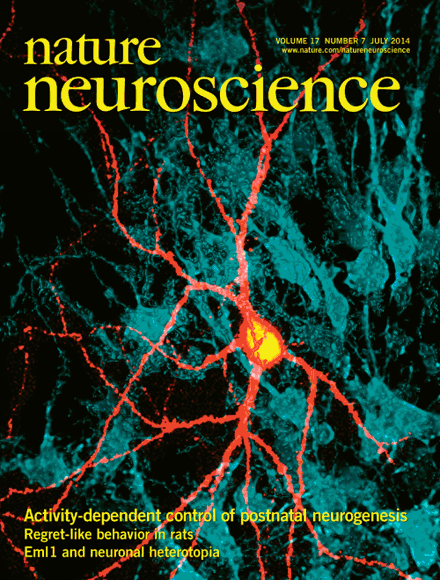
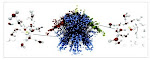
Clade C es el subtipo más prevalente de HIV-1 en el mundo. La estructura cristalina del núcleo de clade C gp120 es descrito por Bjorkman y colegas, en conjunto con el complejo CD4 y el receptor CD4 - inducidos por anticuerpo. El trabajo revela que el anticuerpo hace contacto con ambos, gp120 y CD4. La portada de la revista muestra una escultura de vidrio de una partícula viral realizada por el artistaLuke Jerram (http://www.lukejerram.com/projects/glass_microbiology).pp 608–613
Premio Nobel de Fisiología y Medicina 2011
La Gran Protuberancia
Busca Calderón gastar $2 mil millones menos en innovación tecnológica
2012
Periódico La Jornada Domingo 18 de septiembre de 2011, p. 6
millones los fondos destinados a innovación tecnológica y competitividad de las empresas, pero también en inversión para proyectos de ciencia básica, fomento regional al desarrollo científico e infraestuctura para el sector.
De acuerdo con el proyecto de Presupuesto de Egresos de la Federación (PEF) 2012, para ciencia, tecnología e innovación, que integran recursos para nueve ramos administrativos, incluido el Consejo Nacional de Ciencia y Tecnología (Conacyt), a través del ramo 38, sólo se invertirán 2 mil millones de
pesos en desarrollo tecnológico e innovación cuyo objetivo es impulsar la competitividad de las empresas mexicanas.
Ello significa un recorte de 450 millones de pesos (21.1 por ciento menos, en términos reales) de los fondos aprobados para este año, pese a que estos recursos están destinados a impulsar la innovación tecnológica de negocios de alto valor agregado, tecnologías precursoras e impulso a la competitividad de las empresas.
De continuar esta tendencia en 2012, este rubro perderá más de 30 por ciento de sus fondos, en comparación con lo etiquetado por el Congreso en 2010.
A esto se suma que dos de los 25 centros de investigación coordinados por el Conacyt –para los cuales se demanda un aumento de 485 millones de pesos para alcanzar 4 mil 408.7 millones– enfrentan una reducción presupuestal.
Los centros de Innovación Aplicada en Tecnología Competitivas y de Tecnología Avanzada encaran recortes de 8.5 y 9.3 millones de pesos, respectivamente, pese a que su objetivo es generar ventajas competitivas en las empresas.
Por ello, pese al incremento demandado para el Conacyt, que incluye un aumento por 3 mil 616 millones de pesos, los fondos destinados a gasto operativo y programas complementarios disminuyen en 723 millones, frente a lo aprobado para 2011.
Además, se recortan 200 millones de pesos al fondo de investigación científica básica SEP-Conacyt, así como al fondo de investigación en salud, mientras los recursos destinados al desarrollo científico, tecnológico de innovación regional, tienen una caída de cien millones.
El apoyo para el fortalecimiento y desarrollo de la infraestructura científica y tecnológica también tiene una caída de 305.6 millones de pesos, aunque el gobierno federal reconoce que este rubro tiene una “importancia estratégica para elevar los niveles de innovación y competitividad en el país”.
Los fondos destinados a las actividades científicas, tecnológicas y de innovación en instituciones de educación superior, y de empresas instaladas en el país, también sufren un recorte en la propuesta, al pasar de mil 327.6 millones de pesos a mil 117 millones.
En cuanto a los aumentos por ramo administrativo, los más castigados con incrementos mínimos son salud, con apenas 80.4 millones; medio ambiente con 65.5 millones; además de comunicaciones y transportes con 65.1 millones de pesos.
Víctor Hugo López López
NUNCA TIEMBLA HASTA QUE TIEMBLA
Tratados de Libre Comercio y Obesidad
MERIDA, Mexico -– In less than a generation, Mexicans have gone from a nation of relatively healthy people to a nation confronting an unprecedented health crisis: morbid obesity. The culprit? The NAFTA diet.
Before the implementation of the North American Free Trade Agreement, or NAFTA, in 1994, Mexicans had a wholesome diet consisting of beans, tortillas, chicken and fruits and vegetables. These were prepared at home or in small restaurants called “fondas” (market stalls) by street vendors. Almost always, these meals were “slow food” -– soups, tacos, sauces and regional dishes were made from fresh ingredients, and prepared over the course of several hours.
In the 15 years since NAFTA, however, Mexico has been “invaded” by globalized, highly processed foods served by such fast-food conglomerates as McDonald’s, Burger King, KFC, Taco Bell and Pizza Hut.
The health crisis confronting Mexico is the rapid escalation in morbid obesity throughout society, affecting every demographic group in the nation, even the poorest.
A survey by Mexico’s health ministry revealed that one in four Mexican children between the ages of five and 11 is morbidly obese.
In a recent study, “Obesity: The Epidemic of the 21st Century,” health researcher Federico Siguero argues that “obesity is the most frequent illness among (Mexican) children, followed by diabetes.
“If this trend continues, there will be no government (administration) that will have the resources to treat all of the obese (Mexicans), who will suffer from diabetes, hypertension or another complication,” he stated.
This is reaffirmed by the World Health Organization (WHO), which now labels Mexico the nation with the second highest incidence of morbid obesity in the world, behind the United States. “Risk factors such as being overweight and obesity have increased (in Mexico) in all groups of society, mainly in urban areas, affecting 51.8 percent of women between the ages of 12 and 49 (60 percent in the northern part of the country) and 5.5 percent of children under five,” the WHO reported in its current country profile for Mexico.
The public health crisis precipitated by the change in the Mexican diet is causing alarm among politicians. Mexico is confronting an unprecedented strain on its national health system. Since NAFTA, “there’s been a greater consumption in fats, fried foods, carbonated soft drinks and fruit drinks that contain high levels of sugar,” Tomas Gloria Requena, a deputy in Mexico’s Congress, complained.
“The lifestyle changes –- in both food, level of stress and decreased physical activity, all part of Mexico’s transition to a ‘global economic integration’ are responsible for changes that are detrimental to the health of the Mexican population,” Enrique Salazar, a health care provider, noted. “According to the WHO, 67.9 percent of Mexican men and 68.4 percent of Mexican women are overweight.”
By comparison, 72.6 percent of American men and 75.6 percent of American women are overweight.
Many Mexicans blame global conglomerates, and the failing of their own government for contributing to the health crisis. “In many rural communities," Salazar added, "the government does not provide potable drinking water in the schools, and as a result, children end up drinking soft drinks instead.”
Mexicans drink more soft drinks per capita than any other people in the world, except for Americans.
“We must reduce the number of soft drinks consumed by children and at-risk adults,” added Jorge Quintero Bello, a legislator from the conservative PAN party. “IMSS (Mexico’s Health Ministry) must launch a comprehensive public education campaign.”
The change in the Mexican diet, however, is only one part of a complicated equation. In the course of implementing NAFTA, Mexico has sought greater coordination with both the United States and Canada. This has meant, among other things, aligning Mexican hours to the U.S. daylight and saving time changes, which, for a nation that lies closer to the equator, means more hours in school and at work. More importantly, Mexico, after a heated debate, officially abolished the siesta -– the traditional midday closing of businesses for three or four hours to allow people to go home and share meals with their families. As a consequence, working “9 to 5” means that home-prepared meals are for the majority of Mexicans a thing of the past, and the “super-sized” fast-food alternative is just around the corner.
“I see it every day,” Salazar continued, “children given money to buy a ‘Happy Meal’ and stressed out mothers who can only think of serving a Pizza Hut pizza for dinner. Over time, the junk food takes its toll on the body.”
If Mexico hoped that NAFTA would be a ticket to becoming more like the United States, it may have gotten its wish. One of the unintended consequences of the trade agreement has been to make Mexico a nation in which morbid obesity has become a national health crisis –- just as it has with its neighbor to the north.
Louis Nevaer is a contributor to NAM whose new book, "Managing Hispanic and Latino Employees," will be published in December 2009.
2) A continuación la confirmación de la Organización Mundial de la salud de que la obesidad en México se ha incrementado dramáticamente, acercandose a la de nuestro vecino del TLC, Estados Unidos de Norteamerica:
Objectives: To assess the relationships between adherence to a traditional Mediterranean diet and adiposity indexes, that is, body mass index (BMI) and waist circumference (WC), in a sample from rural Lebanon.
Design: A sample of 798 adults, aged 40–60 years, was selected in continental rural areas of Lebanon for a cross-sectional study. The questionnaire included socio-demographic, anthropometric and dietary sections. The daily consumption frequencies of selected food groups, categorized as positive or negative components, were calculated based on a food frequency questionnaire. Adherence to the Mediterranean diet was assessed using six a priori scores; including the widely used Mediterranean diet score (MDS). Associations between diet scores and BMI and WC were assessed.
MUJER EN LA LUNA
EL DULCE ENCUENTRO DEL ESPERMA Y EL OVULO
ENERGÍA BARATA
Sapo Tecnicolor Capturado por la Cámara.
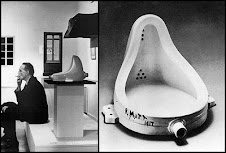
EL ARTE FOMENTA LA CIENCIA
The Battersea Experiment from Dan Tassell on Vimeo.
AUTISMO
LAS APARIENCIAS ENGAÑAN
Las apariencias engañan; estos bellos celenterados (Jellyfish) en botón, realmente saturan los volumenes en donde crecen, y provocan un ahogamiento microbiano, alterando las cadenas alimenticias producuiendo muerte en los sistemas marinos que lo rodean.
PNAS June 6, 2011
Detalles del Universo en 3D
Planetas Huérfanos
DE DONDE OBTENEMOS LA ENERGÍA
La influencia Humana Milenaria
NOCHES DEMASIADO ILUMINADAS
El orígen del Cerebro
1.
Watanabe, K., Kamiya, D., Nishiyama, A., Katayama, T., Nozaki, S., Kawasaki, H., Watanabe, Y., Mizuseki, K. & Sasai, Y. Directed differentiation of telencephalic precursors from embryonic stem cells. Nature Neuroscience 8, 288–296 (2005). article
La Lucha por la Vida
La Esquizofrenia en una Caja de Petri
Las Neuronas de personas con esquizofrnia, creciendo en un cultivo de laboratorio pueden ayudar a conocer las bases genéticas de la enfermedad.Dr. Kristen Brennand, Salk Institute for Biological Studie
- Brennand, K. J. et al. Nature doi:10.1038/nature09915 (2011).
- Takahashi, K. et al. Cell 131, 861-872
- Published online 13 April 2011 | Nature
GENOMA HUMANO, DECIMO ANIVERSARIO
Esperando la Aplicación en la Medicina Primaria
¿De que sirve saber tanto acerca de los genes que tenemos y no tenemos? Si este conocimiento no se aplica a la cura de una enfermedad, por ejemplo.
Science 4 February 2011: Vol. 331 no. 6017 pp. 526-529
La Soledad es Mala Para la Salud
Published online 15 March 2011 | Nature 471, 274 (2011) | doi:10.1038/471274a
News
Choque Gigante Crepita Ideas Acerca de Comportamiento del Temblor
Solo algunos pocos expertos pensaban que la zona sísmica de Sendai, Japón, era capaz de tal violencia.
Richard Monastersky
"Este terremoto es una lección de humildad," nos dice Emile Okal, geofísico de la Universidad Northwestern en Evanston, Illinois, quien estudia grandes terremotos y tsunamis. Y es que muy pocos expertos pensaban que la zona sísmica cercana Sendai, Japón, era capaz de producir terremotos tan devastadores como el que se produjo, de magnitud 9.0 el pasado 11 de Marzo, el más grande sucedido en la história del Japón. Okal y sus colegas desean entender porqué el evento fue mucho más fuerte de lo que muchas personas esperaban — y que significa en cuanto a
riesgos sísmicos en Japón y en cualquier otro sitio del globo.
El terremoto sucedió a lo largo de la línea que divide la placa del Océano Pacifico cerca de la placa tectónica al norte del País nipón. Este tipo de procesos de deslizamiento del borde de una placa de la corteza terrestre por debajo del borde de otra lo cual se denomina subducción dispara los más graves temblores en el mundo, tales como el de
magnitud 9.5 en Chile en 1960 y el de magnitud 9.1 en Sumatra en 2004. Pero los geofísicos habían pensado que los movimientos sísmicos de zonas de subducción como esta, se daban solo cuando las costras de los fondos marinos formadas recientemente empujaban hacía el manto que es la parte densamente rocosa que está más abajo a diferencia de las costras más viejas que más frías y densas se deslizan más suavemente, generando temblores más leves. El caso de la costra enfrente de Sendai, se formó hace unos 140 millones de años, o sea de las costras más viejas del planeta.
La historia de la región de Sendai apoyaban esa idea. "ha habido sismicidad, pero no una sismicidad de grandes terremotos," nos dice Hiroo Kanamori, sismólogo de Instituto Tecnológico de California en Pasadena. En los últimos siglos, la zona de subducción de la costa de Sendai ha generado movimientos telúricos de magnitud 8
cuando más, pero nada cercano al de grado 9, que libera 30 veces más energía.
Dada esta historia, los sismólogos del Japón no consideraban que pudiera suceder un gran terremoto como el del 11 M. Y no obstante que la región es una de las mejor preparadas para tsunamis, las paredes de los los muelles a lo largo de la costa eran considerablemente más pequeñas que las olas de 13–15-metros-de alto que las
abatieron, lo cual causó la mayoría del daño que llevó a la crisis nuclear.
Ahora, algunos otros datos sugieren que la región de Sendai puede ser capaz de violencia aún mayor. El gran terremoto de Sumatra levantó preguntas acerca de la hipótesis de las costras jóvenes, debido a que una situación parecida se dio también, en relación a que la costra de Sumatra es, igual que la de Sendai, geologicamente
muy vieja. Estudios recientes a lo largo del Japón han mostrados que la región de Sendai se esta convirtiendo en muy peligrosa debido a la presión que ejercen las placas tectónicas en la región. Esta conversión sugiere que la placa del Pacífico está empujando de frente chocando, más que deslizando sobre la costra frente al Japón, lo
cual constriñe y causa los fuertes movimientos telúricos.
La energía telúrica formada por el empuje de la placa del Pacífico, mencionada antes, puede ser liberada solo durante un terremoto, pero el empuje es tan constante que el tamaño y la frecuencia de los terremotos vistos en el pasado reciente podrían no ser suficientes para liberar toda la energía. Todo lo fuerte de este terremoto grado 9,
puede ser insuficiente y puede quedar aún mucha energía pendiente de ser liberada.
Malas noticias sin duda.
Lo anterior implica que la zona cercana a Sendai puede producir un gran terremoto como el recientemente sufrido, entonces otras áreas con costras viejas, pueden también producir grandes movimientos telúricos.
El último tsunami gigante de que se tienen registros en Sendai, data del año 869. Y de acuerdo a los depósitos y trazas geológicas de los dos tsunamis anteriores, Koji Minoura, experto de la Universidad de Tohoku de Sendai, propuso en 2001 que las olas gigantes visitan la región cada 800–1,100 años (K. Minoura et al. J. Nat. Disaster Sci. 23, 83–88; 2001). Debido a que el último tsunami se produjo en el siglo 9, los investigadores pronosticaron, la posibilidad de un gran tsunami como el del que motivo esta desgracia.
Fukushima, La Crisis
Fukushima Crisis: Radiation exposure, beyond the numbers - March 15, 2011
This morning, I awoke to a press conference by Chief Cabinet Secretary Yukio Edano rattling out a string numbers on radiation exposure (dutifully recorded in my previous post). This post is intended to explain what these numbers actually mean.
Radiation
Radiation is the generic term given to whatever comes out of heavy atoms when they decay or split apart. It is actually confusing because there are three very different things that can be produced:
Alpha radiation, in which an atom releases a helium nucleus.
Beta radiation, in which an atom releases an electron.
Gamma radiation, in which the atom releases an energetic light particle like an x-ray or gamma-ray.
In the case of the Fukushima situation, there are two major isotopes to worry about. The first, caesium-137, is a gamma emitter. The second, Iodine-131, is a beta emitter.
Sieverts
Because the term "radiation" applies to three different processes, it is not straightforward to figure out how it will affect the body. Gamma radiation is the one that most people probably think about when they think of radiation. This is the powerful stuff that can go through your body, and is used in a lot of medical imaging. It will hurt you for the time you're exposed to the source, but once you leave the area, there is no further risk.
By contrast, alpha and beta radiation cannot penetrate far beyond skin or clothing. These latter types are completely harmless if you're properly protected, but if you ingest or inhale some of the material, it has the potential to make you very ill. That is because once you have taken on alpha or beta radiation, there is no way to escape its effects. It's a bit like carrying an x-ray machine in your chest. Iodine-131 is particularly dangerous because it is readily absorbed by the thyroid and can cause cancer. (It's worth noting that caesium-137, though a gamma emitter, can also be absorbed by the body).
To try and simplify radiation measurements, the international community has introduced the Sievert (Sv). It is actually a complicated quantity to compute, but it attempts to weight the various risks and provide a net value for the biological effects of the radiation detected, no matter the type. A millisievert (mSv) is a thousandth of a sievert, a microsievert (μSv) is a millionth of a sievert.
Exposure
One of the most important and misunderstood aspects of radiation is that the effects are cumulative. That means that when thinking about health effects, the time of exposure is just as important as the dose. For example, the average person receives about 1-2 mSv per year without any bad effects, but if they received a does of 1-2 mSv/minute they would become sick in less than a day.
The peak doses recorded at Fukushima Daiichi have been around 400 mSv per hour, enough to induce radiation sickness in about two hours' time. (That said, the radiation levels appear to be falling, so the situation may not be so bad).
Consequences
One of the most frustrating things has been the lack of information about the various exposure risks. Nowhere on the International Atomic Energy Agency website or elsewhere have I been able to find a clear table of the effects from acute exposure to various levels of radiation (if somebody has one send it my way). The closest thing I've dug up is this table from the World Nuclear Association. It says an instantaneous dose of 1,000 mSv, or 1 Sv, is enough to induce nausea and decrease your white blood-cell count. 5,000 mSv would cause death for 50% of those exposed in a matter of months. 10,000 mSv is guaranteed to be fatal within weeks.
Safety
The safest thing you can do is stay away from radiation. For this reason the government has evacuated some 180,000 residents from 20 kilometres around the Fukushima Daiichi station. Although weather can affect how radioactive debris travels, cities like Tokyo are far enough away to be safe at this stage even if trace amounts of iodine and caesium are detected.
The second safest thing you can do is stay in doors, to prevent exposure to alpha and beta radiation that can't penetrate the building. This morning, the government recommended that residents within 30 km of the plant avoid going outside. Those who do leave their houses would do well to cover up, and change clothes after entering the house (to avoid spreading radioactive dust).
As an added safety measure the government has distributed potassium iodide tablets. These tablets flood the body with safe iodine, preventing the uptake of the dangerous iodine-131.
The good news about radiation is that it decays over time. Iodine-131 has a half-life of 8 days, meaning that it will be half as radioactive after about one week and a quarter as dangerous after two weeks. Caesium-137 has a half-life of 30 years, so it will be around much longer.
Image: An official scans for signs of radiation on a woman in Nihonmatsu City in Fukushima Prefecture March 13, 2011 / REUTERS/Yomiuri Shimbun
Instantáneas Ganadoras en 2010

Los Canales de Schiaparelli

Geographies of Mars: Seeing and Knowing the Red Planet
K. Maria D. Lane University of Chicago Press: 2010. 266 pp. $45
Mosquito Anopheles Suceptible a la Malaria

Un subgrupo del mosquito Anofeles ha sido encontrado recientemente en África Central, es muy abundante, y altamente suceptible a la infección con Plasmodium falciparum (parásito que se mete en las células rojas de la sangre, mostrado en la imagen) agente causal de la Malaria en humanos que al tener contacto con el mosquito se enferman de paludismo.
4 FEBRUARY 2011 VOL 331 SCIENCE
Filme: La Ciencia Brilla en Sundance
Corales Migran a Los Polos
Cambio Climático

Conforme cambia el clima de la Tierra, muchas especies de mariposas salieron más pronto — de sus pupas o de sus escondites — durante la anterior primavera. Los investigadores británicos han identificado lo anterior como la emergencia de mariposas más importante de los últimos 30 años.
Sarah Diamond, de la Universidad de Carolina del Norte, Chapel Hill, y sus colegas analizaron los datos de los investigadores británicos, que como el caso de la especie de mariposa con manchas de "madera" que aparece en la fotografía (Pararge aegeria) durante un período en el que la temperatura subió 1.5 °C. Las mariposas que comieron una menor densidad de comida mostraron mayor movimiento. Los autores sugieren que las mariposas pueden estar teniendo cambios en sus ritmos anuales.
Los autores también se observaron cambios mayores en mariposas adultas, las cuales pueden responder más rápido al entibiamiento del clima.
El Cubo de Hielo Completado

El día en que los investigadores sumergieron uno de los detectores del ‘telescopio’ de neutrinos en un lugar profundo a 2.5 Kilómetros, el Sol antártico estaba tan tibio que se pudo disfrutar de una temperatura de −23 °C.
(A. A. Aguilar-Arevalo et al.Phys. Rev. Lett. 105, 181801; 2010)
TUS OJOS TE DELATAN
REGALO DE NAVIDAD
This gossamer ring in the sky may look as light and lovely as a soap bubble, but its appearance belies its unimaginably violent birth: The shell of reddish gas is actually the remnants of a supernova explosion riding a shock wave and ripping through space at more than 18 million kilometers per hour. The supernova remnant, dubbed SNR 0509, was first spotted by the Hubble Space Telescope in October 2006. This newly released picture combines data from that 4-year-old image, which was taken only at wavelengths that highlight glowing hydrogen, with a visible-light image snapped just last month. SNR 0509, which now appears to be about 23 light-years across, resides in the Large Magellanic Cloud, a galaxy about 160,000 light-years from Earth. When light from the supernova's distant explosion first reached Earth about 400 years ago, it could have outshone its parent galaxy for several days and was probably visible to the naked eye for months. However, there are no records of the event, which was visible from only the Southern Hemisphere.