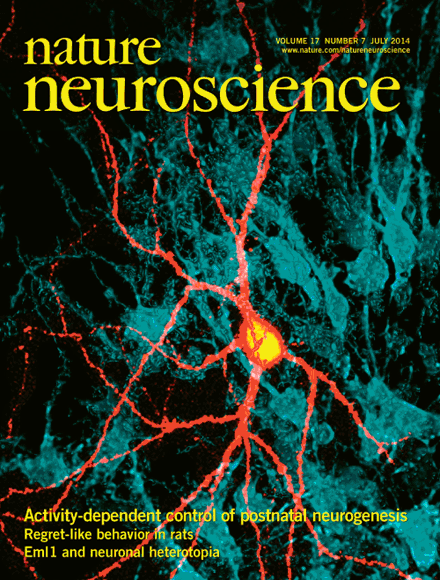
Brain decoding: Reading minds

By scanning blobs of brain activity, scientists may be able to decode people's thoughts, their dreams and even their intentions.

Anne Hathaway's face appears in a clip from the film Bride Wars, engaged in heated conversation with Kate Hudson. The algorithm confidently labels them with the words 'woman' and 'talk', in large type. Another clip appears — an underwater scene from a wildlife documentary. The program struggles, and eventually offers 'whale' and 'swim' in a small, tentative font.

Brain decoding: Reading minds http://www.nature.com/news/brain-decoding-reading-minds-1.13989

LA COL ROJA


¿No es bella?

Progress stalled on coronavirus

Nature | News  

Progress stalled on coronavirus
Lack of in-depth studies hampers efforts to identify source. 


Possible infection with the MERS coronavirus, or a closely related virus, has been detected in camels.
Frank Krahmer/Getty

 A year on from the first reported human case of infection with Middle East respiratory syndrome coronavirus (MERS-CoV), the world still has few answers to the most pressing question from a public-health perspective: what is the source of the steady stream of new cases? Only with this information can the outbreak be controlled.
There have so far been 114 confirmed cases of MERS-CoV infection, including 54 deaths, with another 34 suspected cases (see ‘Catching on’). All originated in the Arabian Peninsula, with most in Saudi Arabia and others in Jordan, Qatar and the United Arab Emirates (UAE). Imported cases have occurred in the United Kingdom, France, Italy and Tunisia. The virus is thought to be an animal virus that sporadically jumps to people — there are no signs yet that it can spread easily between humans, although limited spread between people in close contact has been seen.

Genome-Wide Comparison of Medieval and Modern Mycobacterium leprae

Five European individuals who lived during the Middle Ages provide a look backwards at leprosy

Leprosy was endemic in Europe until the Middle Ages. Using DNA array capture, we have obtained genome sequences of Mycobacterium leprae from skeletons of five medieval leprosy cases from the United Kingdom, Sweden, and Denmark. In one case, the DNA was so well preserved that full de novo assembly of the ancient bacterial genome could be achieved through shotgun sequencing alone. The ancient M. leprae sequences were compared with those of 11 modern strains, representing diverse genotypes and geographic origins. The comparisons revealed remarkable genomic conservation during the past 1000 years, a European origin for leprosy in the Americas, and the presence of an M. leprae genotype in medieval Europe now commonly associated with the Middle East. The exceptional preservation of M. leprae biomarkers, both DNA and mycolic acids, in ancient skeletons has major implications for palaeomicrobiology and human pathogen evolution. 
Science 341, 179 (2013) 

Voyager's Not Gone Yet

La Voyager aún en la Heliosfera

Last summer, it looked like the Voyager 1 spacecraft might have finally reached its ultimate destination. Thirty-five years out from Earth and three times farther from the sun than Pluto, the decrepit spacecraft reported a sharp drop in plasma blowing out from the sun and a sharp jump in cosmic rays streaming in from out in the galaxy.
But three papers published online this week in Science conclude that Voyager 1 has not left the heliosphere—the sun's magnetic bubble inflated by its blowing plasma—and entered interstellar space. That's because Voyager found no accompanying switch from the magnetic field spiraling out from the sun to the magnetic field of interstellar space.
Instead, Voyager has discovered a hybrid part of the heliosphere lying between the heliosphere proper and true interstellar space. And nobody knows how far that hybrid extends and when the spacecraft will actually make humankind's first contact with interstellar space. 

 Science. Volume 340, Number 6140, Issue of 28 June 2013

PLANETA ROSA

Astronomers image pink exoplanet

A magenta exoplanet 17.5 parsecs from Earth is the lowest-mass planet that has ever been directly imaged orbiting a Sun-like star outside the Solar System, NASA announced last week. The Subaru Telescope on Mauna Kea, Hawaii, took pictures of the exoplanet GJ 504b at near-infrared wavelengths with the help of adaptive optics. GJ 504b is four times more massive than Jupiter and, with a surface temperature of 237 °C, still glows pink from its fiery birth 160 million years ago. The rosy planet (pictured in an artist’s impression) orbits the star GJ 504, which can be seen with the naked eye, in the constellation Virgo. With an orbiting radius 43.5 times Earth’s distance from the Sun, GJ 504b challenges current theories of how far away from stars large planets form. The findings will be published in The Astrophysical Journal.

Diverse Crystals Account for Beetle Sheen


Not only are beetles among the most diverse group of animals on Earth, but some rival the most flamboyant birds and dazzling coral reef fish with their metallic sheens. Researchers have now traced the evolutionary history of this iridescence in one group of beetles, the weevils, and identified an unexpectedly varied assortment of complex light-altering crystals in the insects. The new work also shows that these diverse crystal architectures all share a single origin in these beetles' evolutionary past. Weevils "have developed high crystal diversity from a relatively modest tool kit," says Ainsley Seago, a systematist with the Australian National Insect Collection in Canberra, who led the work.

ORIGEN Y EVOLUCION DE LA VIDA.

NUMERO ESPECIAL MONOGRAFICO 
(Hace 16 años)


Cuando platique con el celebre biologo mexicano y del mundo, Toño Lazcano Araujo, de la posibilidad de que nos visitara Stanley Miller, aquel inquieto estudiante graduado de la Universidad de Chicago que había logrado convencer al Doctor Harold Urey de reproducir en una probeta las condiciones que pudo haber tenido la atmósfera primitiva de nuestro planeta, nunca pense en lo grato que resultaría en muchos sentidos.

En primer lugar, en esta casa de trabajo, ARMARIO, todos, especialmente Arturo Chavolla, Cuahtemoc Vite y Maria Luisa Franco me brindaron toda clase de apoyo en relación a la posibiliad de que un suplemento cultural, dedicara, nada menos que todo el número de hoy a un tema que la cultura frecuentemente relega a un segundo o tercer plano o bién ni siquiera considera como importante: La divulgación de un tema científico


En segundo lugar, cuando invité a Javier Ruíz de la Presa a escribir sobre este tema, de inmediato le pareció interesante y hasta estímulante y escribió una colaboración esplendida de la Evolución de la Vida desde “Una perspectiva filosófica”, lo cual une a estas dos partes de la Ciencia la biológica y la humanística, cosa a veces tan dificil de integrar en este fragmentado mundo posmoderno.

Después al hablar con el naturalista jaliscience y Doctor Enrique Estrada Faudon, fué tan amable, que me pareció que la empresa de hacer este número iba a lograrse; Resulta que el Doctor Estrada Faudon es uno de los personajes de las ciencias naturales que ha dado el occidente del país; su experiencia con aspecto juvenil, lo hace imprescindible cuando uno quiere conocer algun aspecto del desarrollo de la Botánica o Geografía del estado de Jalísco. Gracias al Doctor Estrada Faudón presentamos algunas ilustraciones del biólogo mexicano Alfonso L Herrera, que por los años treintas, en plena época cristera, andaba publicando en las mejores revistas francesas los últimos avances de la Biología logrados en su propio laboratorio de la colonia Santa María en la Ciudad de México y en relación con la Plasmogénia o aparición de las primeras formas vivas sobre el planeta.

Por supuesto la aparición de los textos de Miller por un lado y Lazcano por otro, ilustran de manera impecable como la vida sobre la Tierra pudo haber surgido hace unos cuatro mil millones de años y además como esas primeras formas vivas empezaron a desarrollarse, lo cual fué perfectamente captado por JIS en su celebre cartón que dedica en exclusiva a este númeto especial. Precisamente su señor padre el Ingeniero Federico Solorzano, catedrático de “Prehistoria” en el Centro Universitario de Ciencias Sociales y Humanidades, de la Universidad de Guadalajara, nos hace un estupendo recuento de las últimas fases de la evolución: La Evolución de los hominidos precursores del Homo sapiens contemporaneo, discutiendo cuales de los restos arqueológicos de hace unos cien mil años, actualmente encontrados en diversas partes del mundo, corresponde al abuelo del hombre del siglo XXI .

Por último Ulises Iñiguez Mendoza aceptó con amabilidad el reto de colaborar también en este número, desde la perspectiva del cine: Se plantea en su docta colaboración que diferentes cineastas, uno inglés y otro ruso (Kubrick y Tarkovski), de algún modo hicieron una importante incursión en el tema de este número monográfico, por medio de sus obras maestras: 2001: “Una Odisea del Espacio” y “Solaris” respectivamente, demostrando que la cultura es un todo diverso en donde la ciencia y sus ideas permean a todo el actuar humano.

Esperamos que este acontecimiento del número monográfico sea el primero de una serie de números en donde la sociedad intelectual y el ciudadano se enlacen para demostrar que el nivel del periodismo cultural no solo lo constituyen la nota roja y la política sino que también hay sed de ciencia en la comunidad de nuestra región. Enhorabuena. 


PRIMER PLANETA DISTANTE AZUL

First distant planet to be seen in colour is blue

Hubble Space Telescope measures visible light from an exoplanet.


  Blue gas giant.- By observing exoplanet HD 189733 b before, during and after it disappeared behind its host star, astronomers were able to discover that its colour is a deep blue. (Artist's impression.)


A navy-blue world orbiting a faraway star is the first exoplanet to have its colour directly measured. Discovered in 2005, HD 189733 b is one of the best-studied planets outside the Solar System, orbiting a star about 19 parsecs away in the Vulpecula, or Fox, constellation. Previous efforts to observe the planet focused on the infrared light it emits — invisible to the human eye.
Last December, astrophysicist Tom Evans at the University of Oxford, UK, and his colleagues used the Hubble Space Telescope to observe the planet and its host star. Hubble's optical resolution is not high enough to actually 'see' the planet as a dot of light separate from its star, so instead, the telescope receives light from both objects that mix into a single point source. To isolate the light contribution of the planet, Evans and his colleagues waited for the planet to move behind the star during its orbit, so that its light would be blocked, and looked for changes in light colour.

Nature News 11 July 2013


Proof mooted for quantum uncertainty

Study confirms principle’s limits on measurement accuracy.

 Werner Heisenberg’s concept of quantum uncertainty could now be on firmer ground.
INTERFOTO/Alamy

 Encapsulating the strangeness of quantum mechanics is a single mathematical expression. According to every undergraduate physics textbook, the uncertainty principle states that it is impossible to simultaneously know the exact position and momentum of a subatomic particle — the more precisely one knows the particle’s position at a given moment, the less precisely one can know the value of its momentum.
But the original version of the principle, put forward by physicist Werner Heisenberg in 1927, couches quantum indeterminism in a different way — as a fundamental limit to how well a detector can measure quantum properties. Heisenberg offered no direct proof for this version of his principle, and expressed his ideas “only informally and intuitively”, says physicist Jos Uffink of the University of Minnesota in Minneapolis.
Now researchers say that they have a formal proof. “Our work shows that you can’t measure something with an accuracy any better than the fundamental quantum uncertainty,” says Paul Busch, a theoretical physicist at the University of York, UK, who with his colleagues posted the proof on 6 June on the arXiv preprint server1. Not only does the work place this measurement aspect of the uncertainty principle on solid ground — something that researchers had started to question — but it also suggests that quantum-encrypted messages can be transmitted securely.

Proof mooted for quantum uncertainty


FROG IN FLIGHT


Frog in flight — The photo was taken by Andres Andrade from the Center for Genomic Sciences, UNAM, Cuernavaca, Mexico, who works on how bacterial secondary metabolites can participate in the establishment of microbial communities.

RELOG CIRCADIANO LOCALIZADO EN LA ANTENA


Ecology
Getting It Just Right 
Sacha Vignieri  Volume 339, Number 6125, Issue of 15 March 2013
  
North American monarch butterflies are known for the massive southern migrations they undertake each year. During these migrations, a single butterfly may fly over 2500 miles south to the overwintering site, where it enters diapause, a hibernation-like state. This same butterfly will then fly northward in the spring, where it will become reproductive before dying and leaving the remainder of the return trip to its offspring. Monarchs coordinate their southward flight on the basis of a Sun compass mediated through circadian clocks located in the antennae. Guerra and Reppert now show that northbound flight is mediated by the same Sun compass mechanism. This finding begs the question, however, of how individuals are able to "switch" their compasses to fly south in the fall and north in the spring. Exposure of fall remigrants to variations of the day length and temperature conditions encountered at overwintering sites revealed that although day length has no effect on flight direction, temperature was able to facilitate the directional switch. Specifically, butterflies exposed to temperatures that were too warm did not switch their flight directions, whereas those exposed to appropriately cold temperatures flew north as expected. Thus, cold temperatures during overwintering are necessary for the completion of the enigmatic migration. Furthermore, warmer winters at these sites, due to climate change, may interfere with the monarch's migration home.

Curr. Biol. 10.1016/j.cub.2013.01.052 (2013).

The End of the Beginning for the Brain

  • Books et al. Neurobiology
Replicant's end. Publicity still from Ridley Scott's Blade Runner (1982). CREDIT: LADD COMPANY/WARNER BROS./THE KOBAL COLLECTION

Science-fiction novels and films have long popularized the notion that machines will, sooner or later, match and ultimately exceed human-level intelligence. On the way they will acquire feelings and consciousness. In the most famous such movie, Blade Runner, a replicant exclaims in the face of its imminent demise,

"I've seen things you people wouldn't believe. Attack ships on fire off the shoulder of Orion. I watched c-beams glitter in the dark near the Tannhäuser Gate. All those moments will be lost in time, like tears in rain. Time to die."

—revealing in its eloquence and poignancy its (simulated) humanity. 

 Science
Vol. 339
no. 6121 pp. 759-76

ROBOTICS

Tiny, winged machines

Insect-sized robots can mimic the hovering and darting of flies.

Flies have long been admired for their aerial agility, but technical limitations in miniaturization have hindered attempts to replicate this in similar-sized robots. Kevin Ma and his colleagues at Harvard University in Cambridge, Massachusetts, have invented a specialized laser-manufacturing process that allowed them to create tiny composite structures, including mechanical wings and flight muscles. The researchers used the components to build 80-milligram robotic flies with flapping frequency, wing stroke and energy use similar to that of real flies.
 The mechanical flies (pictured) were capable of controlled flight manoeuvres and hovering in place. The work could open the door to additional innovations in miniaturized machines.

Nature 497, 161

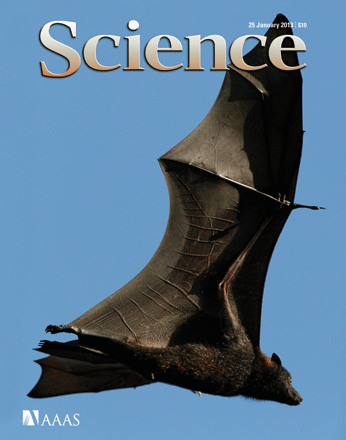
BAT GENOMES

Evolution of Flight and Immunity


A juvenile male Pteropus alecto (black flying fox) spreading its wings (for adults, average wing span: ~1 meter; average weight range: 500 to 1000 grams). Bats, the only mammals capable of sustained flight, are among the world's most diverse mammals and are host to numerous deadly viruses. Comparative genome analyses have shed new light on the evolution of bat-specific traits, including flight and immunity. See page 456. Photo: Martin Asser Hansen/www.maasha.dk 
 
Bats are the only mammals capable of sustained flight and are notorious reservoir hosts for some of the world's most highly pathogenic viruses, including Nipah, Hendra, Ebola, and severe acute respiratory syndrome (SARS). To identify genetic changes associated with the development of bat-specific traits, we performed whole-genome sequencing and comparative analyses of two distantly related species, fruit bat Pteropus alecto and insectivorous bat Myotis davidii. We discovered an unexpected concentration of positively selected genes in the DNA damage checkpoint and nuclear factor κB pathways that may be related to the origin of flight, as well as expansion and contraction of important gene families. Comparison of bat genomes with other mammalian species has provided new insights into bat biology and evolution.  

ScienceVol. 339 no. 6118 pp. 456-460

EL REGRESO DE TRES DINOSAURIOS

1) EL DE TITO MONTERROSO

El dinosaurio
[Minicuento. Texto completo.]

Augusto Monterroso

Cuando despertó, el dinosaurio todavía estaba allí. 
FIN 

 
2) EL DE NATURE

Return of the dinosaur Mongolian researchers have finally got their hands on the Tarbosaurus bataar fossil (pictured) that was illegally smuggled out of Mongolia and came to auction in the United States last year. On 16 April, the team in New York began weighing and measuring the bones of the T. bataar specimen in preparation for customs registration and shipment back to Mongolia, which is expected shortly after it officially becomes Mongolian property on 6 May. The legal status of the fossil had been in limbo since Mongolia disputed its sale for more than US$1 million at a New York auction house last May. The 7.3-metre-long specimen is one of the most complete tyrannosau 


3) EL PRI


Arachnoscelis magnifica


Arachnoscelis magnifica, a predaceous katydid (Orthoptera: Tettigoniidae), on a leaf in the San Lorenzo forest of Panama. This attractive insect is but one of the ~25,000 arthropod species likely to live in this 6000-hectare forest, confirming the formidable diversity of arthropods, which appears to be 300 times that of mammals in tropical rainforests.

DEGRADACIÓN DE LA TIERRA

Drought kills agricultural profit
 
 
Land degradation and desertification are causing huge reductions in agricultural profits in the world’s poorest nations, according to a report presented at the United Nations Convention to Combat Desertification (UNCCD). The first assessment of its kind in more than 20 years calculates that Guatemala, for example, lost 24% of its agricultural gross domestic product to environmental degradation. The findings were presented at the UNCCD’s second scientific conference, on 9 April in Bonn, Germany. Nearly 3.7 million people in East Africa still require food assistance after droughts in Kenya (pictured) and other nations wiped out crops in 2011, the UNCCD says. “Desertification, land degradation and drought are key constraints to building social and environmental resilience, achieving global food security and delivering meaningful poverty reduction,” said UNCCD executive secretary Luc Gnacadja at the meeting.


NATURAL PRODUCTS EMERGENT

Fermentation rooms, at Warp Drive Bio, could open the door to natural product drug discovery


Natural compounds produced by the world’s microbes were once the go-to source of molecules for the drug industry before the chemistry dried up and big pharma went packing. Now, researchers hope that advances in genomics will bring companies back into the fold.

volume 19 | number 4 | april 2013 nature medicine

MEXICAN ARTIST: ATANASIO ECHEVERRIA

VISIBLE EMPIRE

Botanical Expeditions and visual culture in the hispanic enlightenment


From New Spain.

Mexican artist Atanasio Echeverría's watercolor of Erythrina divaricata.

Science 9 November 2012: Vol. 338 no. 6108 pp. 743-744  BOOKS ET AL.
HISTORY OF SCIENCE
Picturing Nature and Empire
Visible Empire Botanical Expeditions and Visual Culture in the Hispanic Enlightenment by Daniela Bleichmar University of Chicago Press, Chicago, 2012. 298 pp. $55, £35.50. ISBN 9780226058535.